
.avif)
Understanding Neurodivergent Masking & Its Hidden Cost
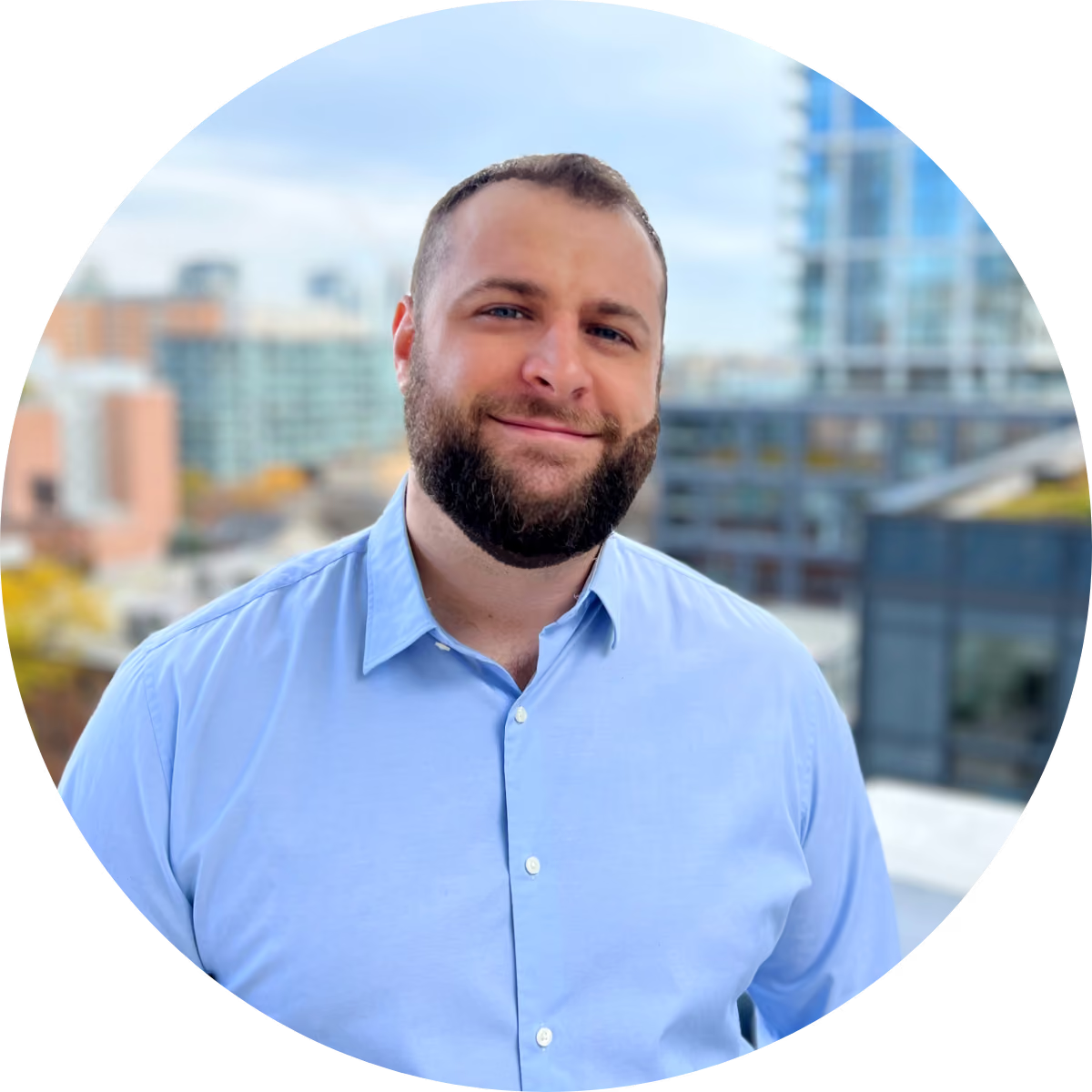
Nick Fink, RP is the founder and director of Mantra Psychotherapy. He has been practicing as a Registered Psychotherapist for five years and has supported hundreds of clients across the Greater Toronto Area and Ontario.
Nick Fink, RP is the founder and director of Mantra Psychotherapy. He has been practicing as a Registered Psychotherapist for five years and has supported hundreds of clients across the Greater Toronto Area and Ontario.
Some people learn early that the version of themselves that feels most natural isn't the version other people want to see. So they build another one. A quieter one. A more agreeable, more eye-contact-making, less-obviously-different one. Over time, that second version can start to feel less like a costume and more like the only self anyone else has ever met.
This is masking, and for many neurodivergent people—particularly those living with ADHD or autism spectrum disorder—it isn't a choice so much as a survival skill picked up before they even had the words for what they were doing.
So, what is masking?
Masking, sometimes called camouflaging, is the conscious or unconscious effort to hide certain neurodivergent traits in order to appear more neurotypical. It can look like forcing eye contact that feels uncomfortable, scripting conversations in advance, suppressing the urge to "stim", pushing through sensory overwhelm without letting it show, or laughing along at things you didn't actually follow.
Masking is often so automatic that people don't realize they're doing it until they're exhausted and can't explain why. I hear this a lot in session: "I don't know what's wrong, I just feel like I've been on all day." That performance has a name, and naming it is often the first step toward understanding it.
The questionnaire researchers developed to measure it breaks masking down into three overlapping strategies: compensating for social difficulties, actively masking traits, and assimilating to avoid standing out. In other words, masking isn't one thing. It's a whole toolkit that gets built, often without anyone consciously deciding to build it.
Why People Mask
Masking usually starts as a response to real consequences: being teased, corrected, excluded, or told directly that the way you naturally move, speak, or process the world is "too much." Interviews with adults on the autism spectrum found the motivation was rarely about deception. It was about fitting in and building connections with the people around them. For a lot of people, especially those diagnosed later in life, masking predates the diagnosis by decades. The mask came first. The explanation for why they needed one came later, if it came at all.
The problem is that masking works, at least on the surface. It gets people through job interviews, first dates, and family dinners. What it doesn't do is come off easily once the immediate danger has passed.
The Cost of Masking
Masking isn't free. A 2024 systematic review and meta-analysis of nearly 6,000 autistic participants found consistent, moderate links between camouflaging and anxiety, social anxiety, and depression, along with lower overall wellbeing. The more consistently someone masks, the more it tends to cost them.
One of the clearest costs is what's now known as autistic burnout: a state of chronic exhaustion, loss of function, and reduced tolerance to everyday stimulation that builds up over time when someone's support doesn't match what they actually need. Researchers who worked directly with adults on the autism spectrum to define this experience described it as a distinct phenomenon from either depression or ordinary burnout, one that specifically comes from the mismatch between what a person's environment expects of them and what they can sustainably give without support.
Burnout doesn’t always look like a crisis from the outside. Often, it looks like a person who was once deemed ‘high-functioning’ suddenly struggling with tasks that used to feel automatic. That drop in capacity isn’t a personal failure—it’s a signal that the mask has become too heavy to carry.
Where Queerness and Neurodivergence Intersect
For many queer and neurodivergent people, masking isn't just a single response to one aspect of their identity—it's two distinct layers of protective performance running at the same time, creating a deeply complex state of constant hyper-vigilance.
Concealing or editing parts of yourself to stay safe, accepted, or simply undetected is a shared thread running through both queer and neurodivergent experiences. Whether navigating coming out, gauging safety in a room, or suppressing a stim, these efforts represent distinct forms of masking. When someone is both queer and neurodivergent, these dynamics don't operate in isolation; they intertwine from the start, compounding the subtle, automatic habit of hiding who you are.
This overlap isn't just anecdotal. A large-scale study using data from over 640,000 people found that transgender and gender-diverse individuals have significantly higher rates of autism diagnoses and autism-related traits than cisgender individuals, a pattern that held up consistently across five separate datasets. This data confirms that if you find yourself navigating both realities at once, you aren't an outlier—your experience reflects a deeply connected human pattern that deserves integrated, understanding care.
For folks who are both queer and neurodivergent, I often see two masks that got built at different points in life, for different reasons, and eventually merged into one. Untangling which parts of "who I am in public" are protective, which are exhausting, and which are actually just them takes time and it's not something to rush.
What Unmasking Can Look Like
Unmasking isn't an all-or-nothing switch, and it isn't safe or realistic in every environment. For most people, it's a gradual process of figuring out where it's actually possible to be less guarded, and building more of those spaces over time. That can mean:
Starting small, in low-stakes settings: Letting a stim happen in front of one trusted person before trying it in a room full of strangers.
Noticing the difference between masking that protects you and masking that's just a habit: Some contexts genuinely require caution. Others don't, even though it can feel that way.
Grieving the effort it took: For a lot of people, realizing how much energy masking has quietly consumed for years is its own kind of loss.
How Therapy Helps
Therapy can be one of the few spaces where unmasking is actively welcomed rather than just tolerated. That might mean working through the exhaustion of years of camouflaging, exploring which parts of an identity are truly yours versus performed for safety, or simply having somewhere to put the mask down for fifty minutes.
Unlearning years of automatic masking isn't about forcing yourself to strip away your boundaries all at once—it’s about safely discovering who you are when you don't have to perform. Therapy offers a dedicated, compassionate space where you can unpack the exhaustion of masking, explore the intersection of your identities, and begin building a life where your authentic self can thrive without constant self-monitoring.
The therapists at our clinic work with neurodivergent and LGBTQ2IA+ clients virtually across Ontario. Book a free phone consultation or fill out our Therapist Matching Form to get started.
References
Hull, L., Mandy, W., Lai, M.-C., Baron-Cohen, S., Allison, C., Smith, P., & Petrides, K. V. (2019). Development and validation of the Camouflaging Autistic Traits Questionnaire (CAT-Q). Journal of Autism and Developmental Disorders, 49(3), 819–833. https://doi.org/10.1007/s10803-018-3792-6
Hull, L., Petrides, K. V., Allison, C., Smith, P., Baron-Cohen, S., Lai, M.-C., & Mandy, W. (2017). "Putting on my best normal": Social camouflaging in adults with autism spectrum conditions. Journal of Autism and Developmental Disorders, 47(8), 2519–2534. https://doi.org/10.1007/s10803-017-3166-5
Khudiakova, V., Russell, E., Sowden-Carvalho, S., & Surtees, A. D. R. (2024). A systematic review and meta-analysis of mental health outcomes associated with camouflaging in autistic people. Research in Autism Spectrum Disorders, 118, 102492. https://doi.org/10.1016/j.rasd.2024.102492
Raymaker, D. M., Teo, A. R., Steckler, N. A., Lentz, B., Scharer, M., Delos Santos, A., Kapp, S. K., Hunter, M., Joyce, A., & Nicolaidis, C. (2020). "Having all of your internal resources exhausted beyond measure and being left with no clean-up crew": Defining autistic burnout. Autism in Adulthood, 2(2), 132–143. https://doi.org/10.1089/aut.2019.0079
Warrier, V., Greenberg, D. M., Weir, E., Buckingham, C., Smith, P., Lai, M.-C., Allison, C., & Baron-Cohen, S. (2020). Elevated rates of autism, other neurodevelopmental and psychiatric diagnoses, and autistic traits in transgender and gender-diverse individuals. Nature Communications, 11, 3959. https://doi.org/10.1038/s41467-020-17794-1
Author's note: The content in this article is for educational purposes only. Please speak with a healthcare provider to obtain appropriate recommendations for any mental health concerns.
Looking for a Therapist?
Our team is comprised of experienced counsellors who are prepared to support a range of psychological concerns and personal challenges. Our clinic provides virtual psychotherapy across Ontario.

.avif)

.avif)
.avif)


.svg)
.svg)
.svg)
.svg)

.svg)