
.avif)
Why Gay Men May Struggle with Intimacy and Vulnerability — and How Therapy Can Help

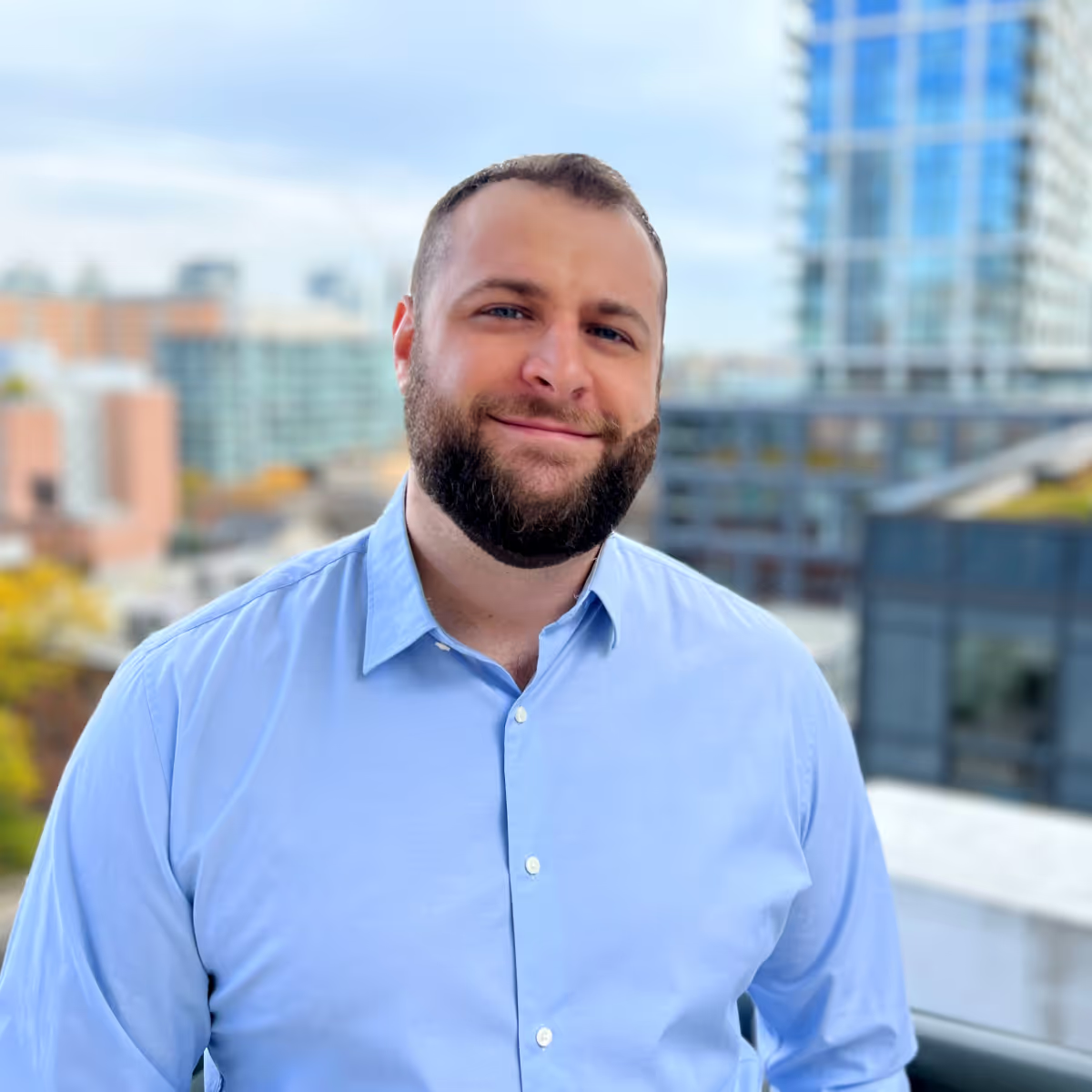
Nick Fink, RP is the founder and director of Mantra Psychotherapy. He has been practicing as a Registered Psychotherapist for five years and has supported hundreds of clients across the Greater Toronto Area and Ontario.
Nick Fink, RP is the founder and director of Mantra Psychotherapy. He has been practicing as a Registered Psychotherapist for five years and has supported hundreds of clients across the Greater Toronto Area and Ontario.
Many gay men describe the same paradox: wanting closeness deeply, and finding it terrifying in equal measure. They show up with rich social lives, ease with physical intimacy (however, not always), and an emotional intelligence that makes them wonderful friends to those around them. And yet, when it comes to being truly known, to letting someone see the unguarded version, something pulls back.
This isn’t a character flaw. It’s a pattern with roots. And understanding those roots is where change begins.
What Years of Concealment Do to Emotional Openness
For most gay men, adolescence meant learning to hide. Not always consciously, but the body learns quickly what’s safe to show and what needs to stay private. A laugh suppressed. A crush unnamed. A version of yourself carefully managed in every room you walked into.
Research shows that concealing sexual orientation is associated with significantly worse mental health outcomes, including anxiety, depression, and psychological distress. This isn't simply because hiding is stressful. It's because concealment trains the nervous system to treat self-disclosure — even to objectively safe people — as a threat. And the deeper wound is often not the concealment itself, but the environment that made it necessary in the first place: the family systems, institutions, and cultural messages that taught someone their authentic self was safer kept hidden. Over time, that concealment doesn’t stay contained to sexual identity. It generalises. Being emotionally open — about fears, needs, grief, love — starts to carry the same risk as coming out once did.
In my clinical work with gay men, I see this play out in a specific way. A client may be warm, perceptive, and deeply attuned to everyone else’s emotional experience, and genuinely unable to identify, let alone express, what they are feeling. The capacity for emotional disclosure was never really developed, because for years, it wasn’t safe to.
The Role of Shame
For gay men, shame isn’t just about sexual orientation, though that’s often where it starts. For many gay men, early messages that same-sex desire was wrong, sinful, or embarrassing become embedded in how they relate to their own inner life. Being truly intimate requires being seen. And if being seen has historically meant being rejected, vulnerability starts to feel less like connection and more like exposure.
Meyer’s minority stress model describes the chronic psychological burden carried by sexual minority individuals navigating a heteronormative world, including the internalised dimension of that stress, where external stigma quietly becomes a private belief about your own worth. When shame lives inside the self, intimacy doesn’t just feel risky. It can feel presumptuous, as if closeness is something you haven’t earned the right to have.
What I find in practice is that shame often operates invisibly. A client may not call it shame. He might say he’s “just not that emotional” or that he “doesn’t really need much from people.” Those framings often sound like personality. But when we slow down and look, they’re almost always protective ways of not needing what once went unmet.
How This Shows Up in Relationships
The patterns look different for different people, but a few come up again and again in my work with clients:
Choosing unavailable partners. If closeness feels unsafe, someone who keeps a certain distance offers a kind of relief. The intimacy gap feels familiar, even comfortable. The longing is real — the pursuit of actual closeness gets unconsciously avoided.
Self-sabotage when things get serious. Emotional depth arrives and something creates distance, conflict, withdrawal, an exit. Not because the relationship isn’t wanted. But because being truly loved and then losing it feels more unbearable than never having it at all.
Sex as a substitute for closeness. Apps and hook-up culture make physical access easy. Emotional access stays rare and frightening. Over time, some gay men develop a practised fluency in sexual intimacy alongside a genuine difficulty with emotional vulnerability, a split that research links directly to internalised homophobia and its effects on relationship quality.
Being the strong one. Asking for support requires revealing our needs. For men who learned early that their needs were inconvenient or unwelcome, being needed feels far safer than needing. The role of emotional caretaker becomes a way to stay connected without exposure.
I see this last pattern particularly often. A client comes in highly functional, deeply caring toward others, and quietly exhausted. He’s never learned to receive what he so readily gives, because receiving requires a kind of surrender that’s never felt safe.
The Pressure from Within the Community
Vulnerability isn’t only shaped by straight spaces. Recent research identifies gay community stress, the status hierarchies, body standards, and competition that can characterise gay social environments, as an independent contributor to psychological distress. When the community that was supposed to be the safe place also runs on a currency of desirability and performance, emotional openness can feel just as dangerous there.
The context noted here is a particular reason that gay men tell me is the reason they seek a gay therapist. To have someone who understands the cultural context that they're coming from is incredibly valuable and contributes the a deep understanding of the concerns, as well as the background, of what they're coming to therapy to address.
What Queer-Affirming Therapy Can Offer
Understanding why vulnerability feels dangerous is the beginning of being able to choose something different. In therapy for gay men, this work might include:
Using CBT to identify and challenge the beliefs underneath avoidance, “if I let him see this, he’ll leave,” “needing things makes me too much,” and build more realistic expectations of what closeness actually costs.
Using DBT concepts and skills to develop emotional literacy and tolerance, the capacity to notice, name, and stay with feelings rather than immediately pushing them away.
Processing the earlier experiences, family rejection, adolescent hiding, and community wounds, that taught the nervous system emotional exposure meant danger. Not to relitigate the past, but to update what the present actually requires.
Research on LGB-affirmative therapeutic approaches has shown meaningful improvements in anxiety, depression, and relational functioning when therapy directly addresses the minority stress context rather than treating it as incidental.
Healing doesn’t mean becoming someone who is never afraid of vulnerability. It means building enough internal safety that vulnerability becomes a choice, rather than something that happens to you, or something you spend your whole life avoiding.
When to Reach Out
If you recognise yourself in any of this, the suppressed needs, the emotional exits, the exhaustion of being everyone’s support while never asking for your own, working with a trauma-informed, LGBTQ2IA+-affirming therapist can help.
At Mantra Psychotherapy, we offer gay men’s therapy and LGBTQ2IA+-affirming care virtually across Ontario, from Toronto & the GTA to Ottawa, London, and Hamilton. Closeness is not something you have to earn. It’s something you can learn to tolerate, and eventually, to want without fear.
A little about us: We’re a virtual psychotherapy clinic serving clients across Toronto, the GTA and Ontario, with a focus on affirming care for gay, queer, and neurodivergent communities. If you’re looking for support, we’d love to connect for a free initial consultation.
References:
Pachankis, J. E., Hatzenbuehler, M. L., Rendina, H. J., Safren, S. A., & Parsons, J. T. (2015). LGB-affirmative cognitive-behavioral therapy for young adult gay and bisexual men: A randomized controlled trial of a transdiagnostic minority stress approach. Journal of Consulting and Clinical Psychology, 83(5), 875–889. https://doi.org/10.1037/ccp0000037
Soulliard, Z. A., Lattanner, M. R., & Pachankis, J. E. (2024). Pressure from within: Gay-community stress and body dissatisfaction among sexual-minority men. Clinical Psychological Science, 12(4), 607–624. https://doi.org/10.1177/21677026231186789
Frost, D. M., & Meyer, I. H. (2009). Internalized homophobia and relationship quality among lesbians, gay men, and bisexuals. Journal of Counseling Psychology, 56(1), 97–109. https://doi.org/10.1037/a0012844
Meyer, I. H. (2003). Prejudice, social stress, and mental health in lesbian, gay, and bisexual populations: Conceptual issues and research evidence. Psychological Bulletin, 129(5), 674–697. https://doi.org/10.1037/0033-2909.129.5.674
Pachankis, J. E., Hatzenbuehler, M. L., Rendina, H. J., Corbin, W. R., & Parsons, J. T. (2020). Sexual orientation concealment and mental health: A conceptual and meta-analytic review. Psychological Bulletin, 146(10), 831–871. https://doi.org/10.1037/bul0000271
Author's note: The content in this article is for educational purposes only. Please speak with a healthcare provider to obtain appropriate recommendations for any mental health concerns.
Looking for a Therapist?
Our team is comprised of experienced counsellors who are prepared to support a range of psychological concerns and personal challenges. Our clinic provides virtual psychotherapy across Ontario.


.avif)

.avif)
.avif)


.svg)
.svg)
.svg)
.svg)

.svg)