
.avif)
Internalized Homophobia: What It Is and How Therapy Can Help

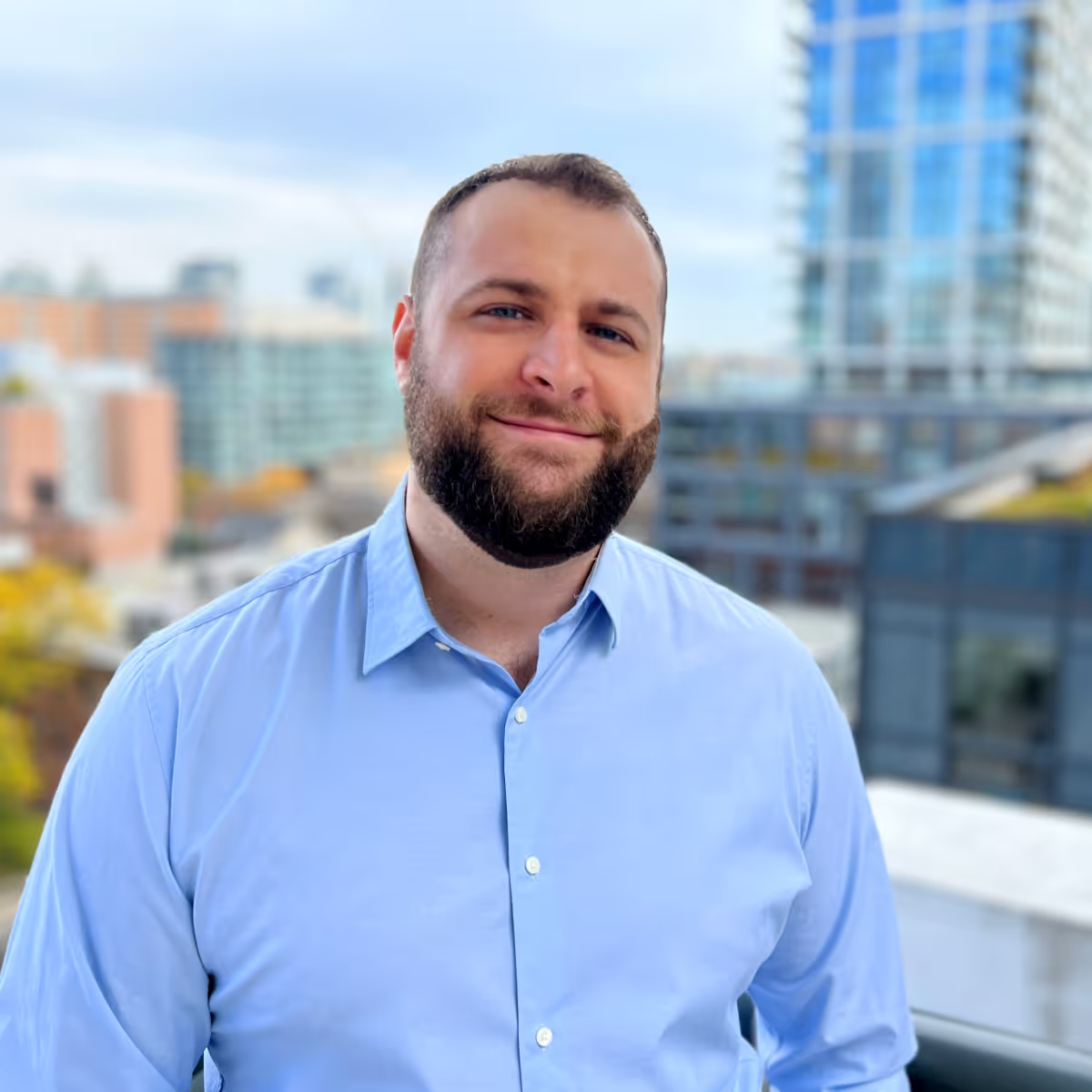
Nick Fink, RP is the founder and director of Mantra Psychotherapy. He has been practicing as a Registered Psychotherapist for five years and has supported hundreds of clients across the Greater Toronto Area and Ontario.
Nick Fink, RP is the founder and director of Mantra Psychotherapy. He has been practicing as a Registered Psychotherapist for five years and has supported hundreds of clients across the Greater Toronto Area and Ontario.
If you've ever caught yourself feeling uncomfortable when two men hold hands in public, and then felt a wave of shame because you're gay, you might already know what internalized homophobia feels like, even if you've never had a name for it.
It's one of those things that can live quietly in the background for years. And for a lot of queer people, naming it is the first step toward actually healing it.
So, What Is Internalized Homophobia?
Internalized homophobia refers to the negative beliefs, shame, and self-directed stigma that LGBTQ2IA+ people can absorb about their own sexual orientation or gender identity. It's what happens when the messaging from a heteronormative world, from media, family, religion, or culture — gets turned inward.
We live in a society that has historically treated queerness as something wrong, deviant, or less than — and research shows that this kind of sustained stigma has measurable effects on mental health. Even when that message isn't explicit, it's often embedded in the small, everyday things: who gets the romantic storyline, whose relationship is treated as "normal," whose identity gets questioned or erased. That's heteronormativity at work. And none of us, no matter how proud or affirming our communities are, grows up completely immune to it.
Internalized homophobia isn't a character flaw. It's a predictable response to an environment that taught you, in ways big and small, that who you are is something to be ashamed of.
Signs of Internalized Homophobia
It doesn't always look like self-hatred. Sometimes it's a lot more subtle:
- Feeling uncomfortable with "visibly" queer people or expressions of identity
- Having persistent anxiety about being perceived as gay
- Minimizing your identity or relationships in certain spaces
- Difficulty feeling proud of your queerness, even when you want to
- Feeling like your attractions are fine "in theory" but still experiencing shame around them
- Avoiding LGBTQ2IA+ spaces, media, or communities
- Struggling to feel deserving of love and partnership
- For gay men specifically, difficulty with intimacy, vulnerability, or trust in relationships
- Using humour to deflect serious conversations about your identity
For many people, these patterns don't even register as homophobia at first. They feel as thought it's anxiety, perfectionism, or just "the way I am." In my work with gay men, I see this regularly — clients who come in for anxiety or relationship difficulties, and it's only once we start digging that internalized shame emerges as the thread running through it all. It rarely announces itself by name. That's part of what makes this work so layered and so important.
How Intersectionality Shapes the Gay Experience
Internalized homophobia doesn't exist in a vacuum, and it doesn't look the same for everyone. Your lived experience, including your race, culture, religion, family background, and the communities you grew up in, shapes how this shows up for you.
For some, religious upbringing adds a layer of spiritual shame that's deeply tied to identity. For others, cultural or family expectations around masculinity, femininity, or marriage create a particular kind of pressure. Queer people of colour often navigate multiple, intersecting forms of stigma that compound what they've had to internalize. Recognizing that intersectionality isn't just relevant, it's essential to doing this work with care and honesty.
Why It's So Hard to See in Yourself
One of the trickiest things about internalized homophobia is that it tends to feel like your own thoughts. It doesn't announce itself as biased or absorbed shame. It shows up as a voice that sounds like you, telling you that you're too much, that something's off, that you should dial it back. I've had clients who were openly and proudly queer for years before realizing that some of what they'd chalked up to personality — the self-monitoring, the discomfort in certain spaces — was actually this.
That's why so many people don't recognize it until they're already in a safe space where they feel held enough to look at it honestly. Sometimes it takes a trusted friend, a community, or a therapist to gently reflect back what's been happening.
How Therapy Can Help Address Internalized Homophobia
The good news is that this is absolutely something that can be worked on, and you don't have to do it alone.
Therapeutic approaches like CBT (Cognitive Behavioural Therapy) can help you identify and challenge the internalized beliefs driving shame and avoidance. DBT (Dialectical Behaviour Therapy) offers tools for tolerating distress and building a more stable, compassionate relationship with yourself. Trauma-informed care is especially important here, because for many LGBTQ2IA+ people, the roots of internalized homophobia are genuinely traumatic, even when the trauma was slow, ambient, and hard to name. What I find in practice is that naming it — having a word for what's been happening — often brings validation for one's experience, even before the deeper work begins.
What makes this work different in an affirming context is that you don't have to explain yourself, justify your identity, or worry about being misunderstood. The Canadian Psychological Association has established guidelines for affirming practice with LGBTQ2IA+ clients — it's worth knowing what that standard actually looks like. Affirming LGBTQ2IA+ therapy, done well, meets you where you are, with full recognition of your sexual orientation, your history, and the world you've had to navigate to get here.
At our clinic, we offer queer-affirming therapy in Toronto and across Ontario provided by therapists who bring both clinical training and an understanding of queer experience to the room. Whether you're looking for support with gay men's mental health, gender-affirming care, or simply a place to work through the quiet shame that's been following you around, we're here for that.
You Deserve to Actually Feel Good About Who You Are
With the right emotional support and a genuinely safe space, a lot can shift. People find that the shame that felt like a permanent fixture starts to loosen. That pride becomes something real, not just something performed.
If any of this resonated with you, reaching out to find a therapist who gets it can be one of the most meaningful things you do for yourself. You don't have to wait until things feel worse to ask for help.
A little about us: We're a virtual psychotherapy clinic serving clients across Toronto, the GTA, and Ontario, with a focus on affirming care for queer, trans, and neurodivergent communities. If you're looking for LGBTQ2IA+ therapy or gay men's therapy in Toronto, the GTA, or Ontario, we'd love to connect for a free initial consultation.
References:
Meyer, I. H. (2003). Prejudice, social stress, and mental health in lesbian, gay, and bisexual populations: Conceptual issues and research evidence. Psychological Bulletin, 129(5), 674–697. https://doi.org/10.1037/0033-2909.129.5.674
Herek, G. M. (2004). Beyond "homophobia": Thinking about sexual prejudice and stigma in the twenty-first century. Sexuality Research and Social Policy, 1(2), 6–24. https://doi.org/10.1525/srsp.2004.1.2.6
Crenshaw, K. (1989). Demarginalizing the intersection of race and sex: A black feminist critique of antidiscrimination doctrine, feminist theory and antiracist politics. University of Chicago Legal Forum, 1989(1), Article 8. https://chicagounbound.uchicago.edu/uclf/vol1989/iss1/8/
Canadian Psychological Association. (n.d.).Section on Sexual Orientation and Gender Identity.https://cpa.ca/sections/sexualorientationandgenderidentity/
Author's note: The content in this article is for educational purposes only. Please speak with a healthcare provider to obtain appropriate recommendations for any mental health concerns.
Looking for a Therapist?
Our team is comprised of experienced counsellors who are prepared to support a range of psychological concerns and personal challenges. Our clinic provides virtual psychotherapy across Ontario.



.avif)

.avif)
.avif)


.svg)
.svg)
.svg)
.svg)

.svg)