
.avif)
How Queer-Affirming Therapy Can Help Gay Men Address Internalized Homophobia & Chronic Shame

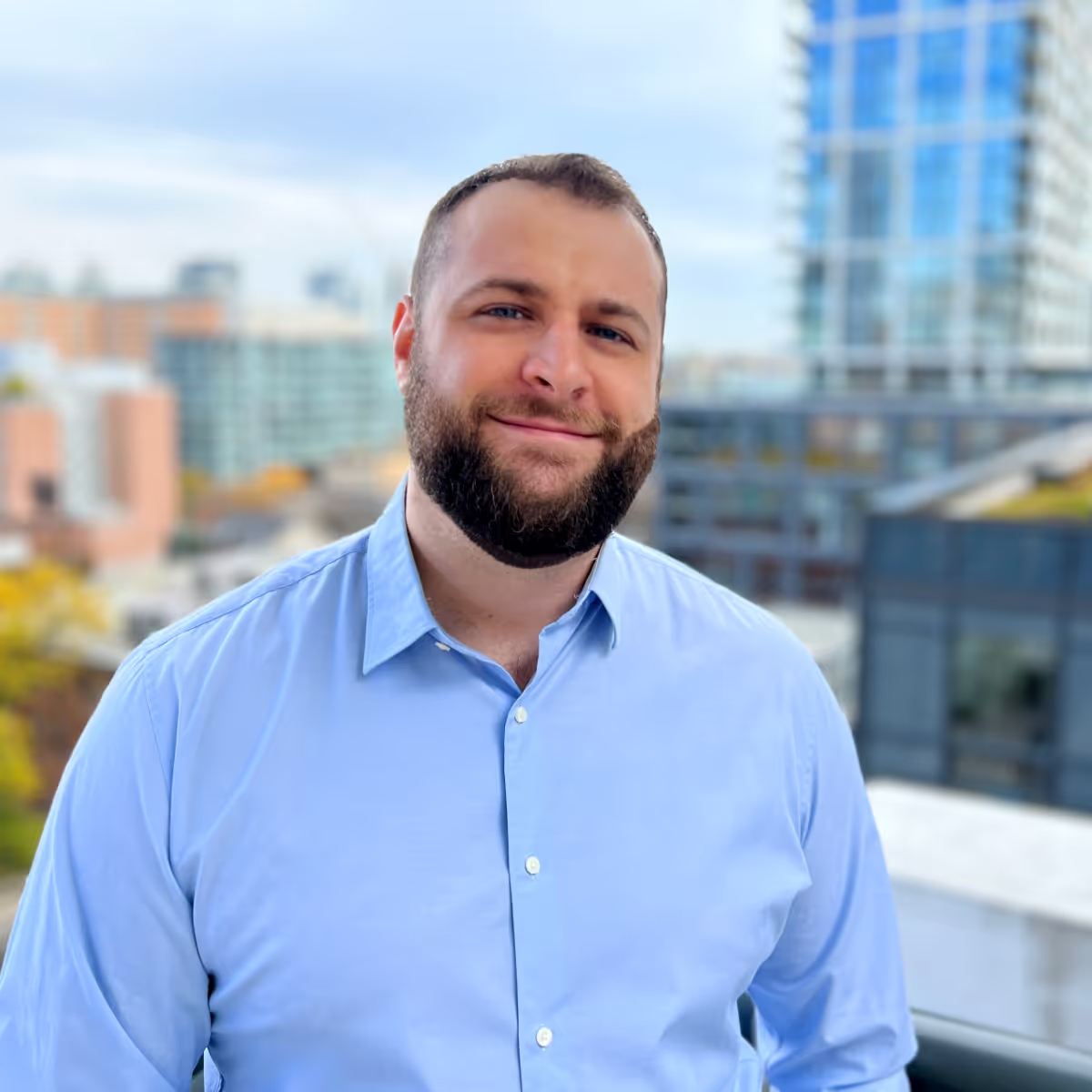
Nick Fink, RP is the founder and director of Mantra Psychotherapy. He has been practicing as a Registered Psychotherapist for five years and has supported hundreds of clients across the Greater Toronto Area and Ontario.
Nick Fink, RP is the founder and director of Mantra Psychotherapy. He has been practicing as a Registered Psychotherapist for five years and has supported hundreds of clients across the Greater Toronto Area and Ontario.
Shame is one of the quietest, most persistent forms of suffering there is. Unlike anxiety, which announces itself, shame tends to operate in the background — colouring how you see yourself, how you show up in relationships, and what you believe you deserve.
For many gay men, shame isn't a passing feeling. It's a long-term companion. And more often than not, it has roots in something specific: growing up in a world that treated your identity as something to be fixed, hidden, or rejected..
If that resonates, you're not alone — and you're not broken. What you're likely dealing with has a name, and it responds well to the right kind of support.
What Is Internalized Homophobia?
Internalized homophobia refers to the negative beliefs and self-directed stigma that gay men can absorb about their own sexual orientation — what happens when the messaging of a heteronormative world gets turned inward.
Research on minority stress consistently shows that stigma and discrimination create a chronic psychological burden for gay men that accumulates over time, regardless of how affirming a person's current environment is (Meyer, 2003). What makes it particularly difficult to address is that it rarely announces itself as homophobia. It shows up as:
- A persistent sense of not being enough
- Anxiety about being perceived as "too gay"
- Difficulty trusting or being vulnerable in relationships
- Shame around desire or intimacy
- Relentless perfectionism — as if being exceptional enough might compensate for being gay
For many gay men, these patterns feel like personality traits rather than responses to a hostile environment. That misattribution is one of the things therapy works to gently untangle.
In my work with gay men, internalized homophobia rarely walks through the door labelled as such. Clients more often come in describing anxiety, low self-esteem, or relationship difficulties. It's only once we explore the history underneath those concerns that shame around identity surfaces — and for many, even naming it for the first time can bring some immediate, if complicated, relief.
Chronic Shame vs. Guilt
Guilt says: I did something bad. Shame says: I am something bad.
For gay men who grew up receiving consistent messages that who they are is wrong, shame becomes not just a feeling but a lens — filtering every experience through a belief in fundamental unworthiness. Chronic shame is particularly resistant to logic. You can know intellectually that there is nothing wrong with being gay, be out and surrounded by community, and still feel the pull of that old internalized narrative. That's not a weakness. That's what happens when shame gets encoded early and never properly processed.
What I find in my practice is that chronic shame is often held in the body as much as the mind. Clients describe a habitual guardedness they weren't aware of until it started to soften. The cognitive work matters, but shame needs to be met relationally — in a space where someone experiences being fully seen as themselves without judgment.
What Queer-Affirming Therapy Actually Means
"Affirming" has become something of a marketing term, which makes it worth being specific about what it means in practice.
Queer-affirming therapy is not simply a therapist who is “accepting” of 2SLGBTQIA+ clients. Acceptance sets a low bar. Affirming care means your therapist understands heteronormativity and its psychological effects, has genuine familiarity with queer lived experience, and won't require you to educate them in session. When looking for 2SLGBTQIA counselling in Toronto or Ontario, ask prospective therapists direct questions: What experience do you have with gay men specifically? How do you understand and approach internalized homophobia? A therapist genuinely equipped for this work will likely answer with specificity.
For gay men navigating internalized shame, the therapeutic relationship itself is part of the treatment. Being genuinely seen — without flinching, without caveats — is a corrective experience that begins to counter the message that your identity is something to be managed or hidden.
I've worked with gay men who had been in therapy before but never actually talked about being gay. It was treated as background information rather than something central to understanding the person. It’s not that simply being gay requires a specific treatment in therapy, but rather that the experience of growing up gay in a non-affirming world requires a specific understanding. The focus is the profound impact of navigating that environment, not on the sexual orientation itself.
How CBT, DBT, and Trauma-Informed Care Help
Several approaches are particularly well-suited to this work.
Cognitive Behavioural Therapy (CBT) helps identify and challenge the internalized beliefs driving shame and avoidance — the hypervigilance to rejection, the assumption of negative judgment, the minimizing of one's own needs. These patterns were often adaptive in an unsafe environment but often cause significant suffering in adult life.
Dialectical Behaviour Therapy (DBT) builds emotional regulation skills and emphasizes radical acceptance — learning to hold your identity with full acknowledgment rather than the qualified, contingent acceptance many gay men learned to offer themselves.
Trauma-informed care is essential because for many gay men, the roots of internalized homophobia are genuinely traumatic, even when the trauma was slow and ambient rather than a single defining event. A trauma-informed approach addresses what the nervous system has been holding alongside the cognitive and emotional work.
Research supports the effectiveness of affirming CBT specifically: a randomized controlled trial found meaningful reductions in depression, anxiety, and internalized stigma among gay and bisexual men receiving minority-stress-focused therapy (Pachankis et al., 2022).
Finding the Right Support
If you're looking for gay men's therapy in Toronto or anywhere across Ontario, the most important thing is finding a therapist who brings both clinical training and genuine familiarity with queer experience. You shouldn't have to explain heteronormativity or spend your sessions educating someone who is otherwise well-meaning.
At our clinic, our queer-affirming therapists specifically focus on gay men's mental health, internalized homophobia, chronic shame, and trauma. If any of this resonated, a free consultation is a good place to start.
Frequently Asked Questions
Can you have internalized homophobia if you're out and proud?
Yes. Being out doesn't automatically undo years of absorbed messaging. Many openly queer men still carry pockets of internalized shame that surface in specific relationships or situations. Coming out is meaningful, but it's often not the finish line.
Do I need to have experienced serious trauma for therapy to help?
No. Many gay men haven't experienced a singular traumatic event— what they've experienced is years of accumulated moments of erasure and rejection. A trauma-informed therapist will recognize that slow, ambient harm as real and treatable.
How long does this kind of therapy take?
It varies. Some people notice meaningful shifts within a few months. For others, where there's deeper trauma involved, it's a longer process. What most people find is that having a genuinely safe space to explore these things openly brings relief on its own, even early on.
References
Meyer, I. H. (2003). Prejudice, social stress, and mental health in lesbian, gay, and bisexual populations. Psychological Bulletin, 129(5), 674–697. https://doi.org/10.1037/0033-2909.129.5.674
Pachankis, J. E., et al. (2022). LGBQ-affirmative cognitive-behavioral therapy for young gay and bisexual men's mental and sexual health: A three-arm randomized controlled trial. Journal of Consulting and Clinical Psychology, 90(6), 459–477. https://doi.org/10.1037/ccp0000724
Author's note: The content in this article is for educational purposes only. Please speak with a healthcare provider to obtain appropriate recommendations for any mental health concerns.
Looking for a Therapist?
Our team is comprised of experienced counsellors who are prepared to support a range of psychological concerns and personal challenges. Our clinic provides virtual psychotherapy across Ontario.



.avif)

.avif)
.avif)


.svg)
.svg)
.svg)
.svg)

.svg)