
.avif)
Common Ways That Trauma Shows Up in Relationships

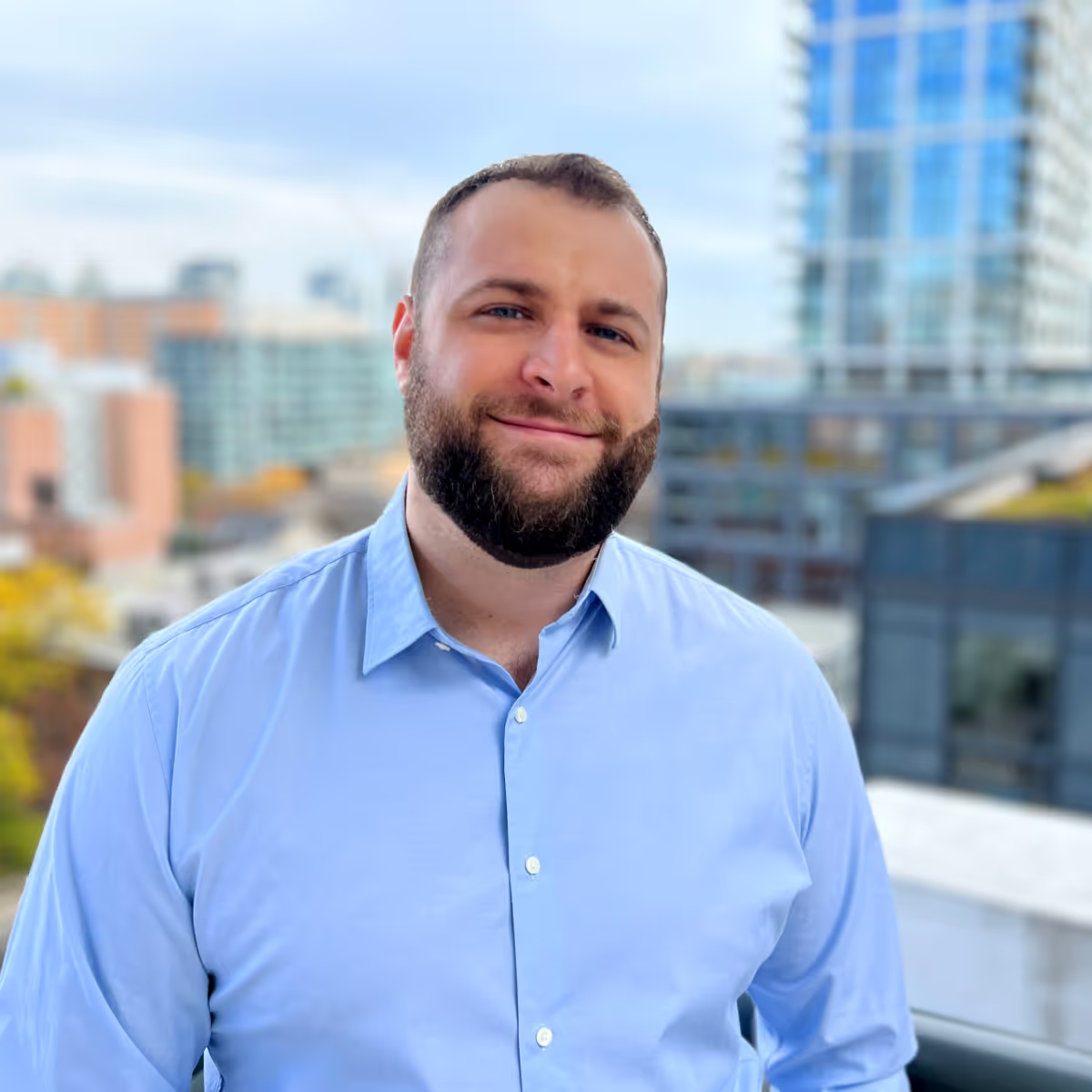
Nick Fink, RP is the founder and director of Mantra Psychotherapy. He has been practicing as a Registered Psychotherapist for five years and has supported hundreds of clients across the Greater Toronto Area and Ontario.
Nick Fink, RP is the founder and director of Mantra Psychotherapy. He has been practicing as a Registered Psychotherapist for five years and has supported hundreds of clients across the Greater Toronto Area and Ontario.
Relationships can be one of the most healing parts of life, and one of the most activating. If you've ever found yourself pulling away when things get close, reacting intensely to something that "shouldn't" bother you, or noticing the same patterns repeat no matter who you're with, trauma may be part of the story.
This isn't about blame. It's about understanding. The ways we learned to survive difficult experiences don't stay neatly in the past — they travel with us into the relationships we love.
What We Mean When We Talk About Trauma
Research shows that childhood trauma, including emotional neglect and relational instability, significantly shapes adult relationship satisfaction, with attachment insecurity as a key pathway. Growing up in a home where conflict felt unsafe, navigating heteronormative environments as a queer or trans person, or experiencing repeated rejection and not feeling seen for who you are can all leave lasting marks on how we relate to others.
At Mantra Psychotherapy, we often work with clients who don't initially identify their history as "traumatic." And yet they find that certain relational experiences trigger responses that feel much bigger than the moment warrants. That intensity is often a signal worth paying attention to.
In my practice, I often see clients who arrive describing relationship anxiety, communication difficulties, or a pattern of pushing people away — and it's only through careful exploration that earlier experiences emerge as the thread running through it. Part of the work is simply helping people see that what they've experienced has a name, and that their responses make sense given what they've been through.
The Nervous System Doesn't Know It's in the Past
Polyvagal Theory offers a widely used clinical framework here: the autonomic nervous system continuously scans the environment for cues of safety and threat through a process called neuroception. For trauma survivors, this scanner is often more calibrated toward danger. It responds to relational cues — a shift in tone, a moment of silence, a cancelled plan — as if the original threat is happening right now.
This can look like:
- Sudden emotional withdrawal, "going cold," or intense anxiety that appears to come out of nowhere
- Intense reactions to conflict that feel disproportionate to the situation
- Difficulty trusting a partner's intentions even when they've given you no reason not to
- Becoming overwhelmed during emotionally charged conversations
- Shutting down in moments when vulnerability is called for
These aren't character flaws. They're protective adaptations — responses that once kept you emotionally or physically safer.
What I find clinically is that trying to “logic” your way out of a relational trauma response doesn’t always work. A person may know, intellectually, that their partner is trustworthy — and still find their body braced for rejection the moment things get emotionally close. That gap between knowing and feeling is one of the most important things we work with in trauma-informed therapy.
Common Relational Patterns Shaped by Trauma
Research on attachment and trauma confirms that early experiences shape "internal working models" — unconscious templates for how available and trustworthy we expect others to be. These templates don't disappear in adulthood; they quietly organize how we respond when things get close.
Why Queer and Trans Experiences Add Another Layer
Meyer's minority stress model identifies the chronic stressors unique to marginalized sexual identities — stigma, discrimination, and concealment — as significant contributors to psychological distress. These stressors don't just affect individual wellbeing; they shape how lesbian, gay, and bisexual people experience and navigate intimate relationships.
More recent research was among the first to examine the combined role of psychological trauma and heterosexist minority stressors in PTSD and complex PTSD among LGBTQ2IA+ adults, finding that minority stressors were independently associated with trauma symptoms, above and beyond other forms of adversity. These findings point to an important clinical reality: for many queer clients, trauma and minority stress are not separate phenomena — they are deeply entangled.
Many clients arrive carrying both personal and systemic relational wounds, and healing this requires a therapist who understands both layers. Whether you're searching for gay men's therapy or LGBTQ2IA+-affirming support in Toronto, the GTA, or Ontario, having that context held in the room makes a real difference.
Many queer clients I've worked with describe a kind of low-grade bracing in intimacy — an expectation that closeness will eventually be met with rejection or withdrawal. This is often rooted not in any one relationship, but in a lifetime of subtle and not-so-subtle messages that their love was somehow less safe to express. Naming that context matters. It shifts the story from 'something is wrong with me' to 'something was wrong with the environment I grew up in.'
What Healing Can Look Like — Queer-Affirming Therapy in Toronto and Ontario
Understanding how trauma affects your relationships doesn't mean you're doomed to repeat old patterns. It means you have a place to start.
In therapy, this work might involve:
- Learning to recognize and name your nervous system's activation in real time
- Understanding the origins of your relational patterns without shame
- Building distress tolerance and emotional regulation skills through DBT
- Using CBT to challenge the core beliefs driving relational anxiety or avoidance
- Processing earlier experiences with trauma-informed modalities that work with the body, not just the mind
- Gradually expanding your capacity to tolerate closeness, conflict, and uncertainty without automatically retreating
Healing isn't about becoming someone who never gets triggered. It's about building enough internal safety that you have a choice in how you respond, rather than reacting from an old script.
When to Reach Out
If you recognize yourself in any of this, if you've wondered why closeness feels complicated, why conflict tends to go sideways, or why certain relationships seem to follow the same painful arc - working with a trauma-informed therapist can help.
At Mantra Psychotherapy, we offer trauma-informed, LGBTQ2IA+-affirming therapy in Toronto and across Ontario. Whether you're working through childhood wounds, identity-based trauma, or relational patterns you haven't been able to shift on your own, we're here to help you build something different.
A little more about us: Our virtual clinic serves clients across Ontario, from Toronto & the GTA to Ottawa, London, and Hamilton, with a focus on affirming care for queer and neurodivergent communities. If you're looking for LGBTQ2IA+ therapy or trauma-informed therapy in Ontario, we'd love to connect for a free initial consultation.
References:
Quan, L., Zhang, K., & Chen, H. (2025). The relationship between childhood trauma and romantic relationship satisfaction: The role of attachment and social support. Frontiers in Psychiatry, 15, 1519699. https://doi.org/10.3389/fpsyt.2024.1519699
Porges, S. W. (2022). Polyvagal theory: A science of safety. Frontiers in Integrative Neuroscience, 16, 871227. https://doi.org/10.3389/fnint.2022.871227
Fonagy, P., Campbell, C., & Luyten, P. (2023). Attachment, mentalizing and trauma: Then (1992) and now (2022). Brain Sciences, 13(3), 459. https://doi.org/10.3390/brainsci13030459
Meyer, I. H. (2003). Prejudice, social stress, and mental health in lesbian, gay, and bisexual populations: Conceptual issues and research evidence. Psychological Bulletin, 129(5), 674–697. https://doi.org/10.1037/0033-2909.129.5.674
Charak, R., et al. (2023). Factor structure of the international trauma questionnaire in trauma exposed LGBTQ+ adults: Role of cumulative traumatic events and minority stress heterosexist experiences. Psychological Trauma, 15(4), 628–636. https://doi.org/10.1037/tra0001440
Walker, P. (2013). Complex PTSD: From surviving to thriving. Azure Coyote Publishing.
Author's note: The content in this article is for educational purposes only. Please speak with a healthcare provider to obtain appropriate recommendations for any mental health concerns.
Looking for a Therapist?
Our team is comprised of experienced counsellors who are prepared to support a range of psychological concerns and personal challenges. Our clinic provides virtual psychotherapy across Ontario.


.avif)

.avif)
.avif)


.svg)
.svg)
.svg)
.svg)

.svg)